

Kai Settings
Configure Kai's tool permissions, system instructions, context files (knowledge files), and skill files — in the UI or programmatically via the Storage Files API.
Kai’s settings let you personalize how Kai behaves in your project. Open the Kai chat panel and click the Settings icon (gear) to access them. Settings are per-user and per-project, so each team member can configure their own preferences independently.
The settings panel has two tabs: Tool Permissions and System Instructions. Project-wide customization — project-level instructions, context files, and skill files — is managed in Settings → Kai Assistant in the main Keboola navigation.
Tool Permissions
Section titled “Tool Permissions”Tool Permissions let you control which tools Kai is allowed to use. This eliminates the need to manually approve each action — you can pre-approve tools you trust and block those you don’t want Kai to use.
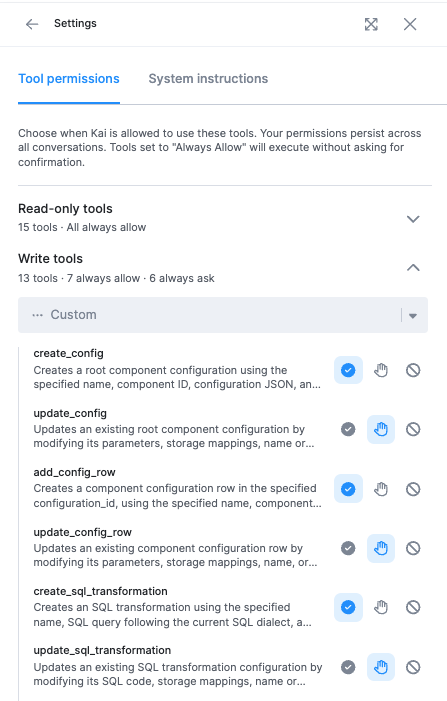
Tool Categories
Section titled “Tool Categories”Tools are organized into two categories:
- Read-only tools — Tools that only read data from your project (e.g., listing tables, reading configurations). By default, all read-only tools are set to Always allow.
- Write tools — Tools that can create or modify resources in your project (e.g., creating configurations, updating transformations, running jobs).
Permission Levels
Section titled “Permission Levels”For each tool, you can set one of three permission levels:
| Permission | Behavior |
|---|---|
| Always allow | The tool runs automatically without asking for confirmation. |
| Always ask | Kai must request your approval each time before using the tool. |
| Block | The tool is completely disabled and Kai cannot use it. |
Setting Permissions
Section titled “Setting Permissions”You can configure permissions in two ways:
- From the Settings panel — Open Settings → Tool Permissions, find the tool, and select the desired permission level.
- From the approval dialog — When Kai requests approval for a tool, click Always allow to automatically approve that tool for all future uses.
Your permissions persist across all conversations within the same project.
System Instructions
Section titled “System Instructions”System Instructions let you provide Kai with persistent context and guidelines so you don’t have to repeat yourself in every chat. Instructions exist at two levels: project-level (shared across all users) and user-level (personal to you). User-level instructions amend project-level instructions — both are included in every conversation.
Project-Level Instructions
Section titled “Project-Level Instructions”Project-level instructions apply to all users in the project. They are managed in the project settings:
- Go to Settings → Kai Assistant in the main Keboola navigation.
- Enter your instructions in the System instructions text field.
- The instructions auto-save.
Use project-level instructions for team-wide standards such as:
- Naming conventions — e.g., “Always prefix staging tables with
stg_and use snake_case for all column names.” - Coding standards — e.g., “Write SQL transformations using CTEs instead of subqueries. Always include comments explaining business logic.”
- Project context — e.g., “Our fiscal year starts in April. Revenue calculations should exclude returns and use the
completed_atdate.”
Project-level instructions can be edited by project admins and managers.
User-Level Instructions
Section titled “User-Level Instructions”User-level instructions are personal to you and are added on top of the project-level instructions. They are configured in the Kai chat panel:
- Open the Kai chat panel
- Click the Settings icon.
- Select the System Instructions tab.
- Enter your instructions in the text field
- The instructions auto-save
Use user-level instructions for personal preferences such as:
- Response style — e.g., “Keep explanations concise. Always show the SQL query before executing it.”
- Preferred workflows — e.g., “Always create transformations in a dev branch first.”
- Language or formatting — e.g., “Respond in German. Use metric units.”
How Instructions Are Applied
Section titled “How Instructions Are Applied”When you start a conversation with Kai, both levels of instructions are included:
- Project-level instructions are applied first.
- User-level instructions are appended on top.
This means user-level instructions can refine or add to the project-level instructions but cannot override Kai’s core system rules.
- Each instruction field supports up to 4,000 characters.
- Keep instructions clear and specific — vague guidelines are less effective.
- Update instructions as your project evolves and conventions change.
- Focus on rules Kai can’t infer from your project data alone (e.g., business logic, team preferences).
- If Kai doesn’t seem to follow an instruction, try rephrasing it more directly.
- For knowledge that outgrows the 4,000-character limit — data standards documents, business glossaries — use context files instead.
Context Files
Section titled “Context Files”Context files (also called knowledge files) are Markdown documents that Kai reads automatically at the start of every conversation. Use them to give Kai project knowledge that is too long for system instructions: data standards, naming conventions, business glossaries, or documentation of your data model.
To manage them, go to Settings → Kai Assistant in the main Keboola navigation and use the Context files card:
- Click Upload and select a Markdown (
.md) file. - The file is uploaded and takes effect in every new conversation (running conversations are not affected).
- To replace a file, upload the new version and delete the old one.
Rules and limits:
- Format: Markdown (
.md) only. - Size: up to 50 KB per file.
- Count: up to 10 files per project.
- A file named
CLAUDE.mdbecomes Kai’s top-level memory file; all other files are loaded as always-on rules alongside it. - Context files apply project-wide — every user’s conversations include them.
Under the hood, context files are ordinary Storage Files tagged kai-context, which means you can also manage them programmatically — see Managing Files via API or CLI.
Skill Files
Section titled “Skill Files”Skills are reusable, on-demand playbooks that appear in the chat’s / slash-command menu alongside Kai’s built-in skills. Unlike context files, Kai loads a skill only when it is invoked — making skills the right place for longer, task-specific instructions (e.g., “build the monthly report,” “onboard a new data source”) that shouldn’t consume context in every chat.
Manage them in Settings → Kai Assistant using the Skill files card. Two formats are accepted:
-
A single
.mdfile starting with YAML frontmatter. Thenameanddescriptionfields are required — the description tells Kai when to invoke the skill:---name: monthly-reportingdescription: Build the monthly revenue report. Use when the user asks for the monthly report or KPI refresh.---# Monthly reportingStep-by-step instructions for Kai... -
A
.skillarchive — a ZIP file with aSKILL.mdat its root (or at the root of a single top-level directory), plus any supporting files the skill references.
Rules and limits:
- Size: up to 50 KB per file.
- Count: up to 10 skill files per project.
- A project skill with the same
nameas a built-in skill replaces the built-in one.
Skill files are Storage Files tagged kai-skill.
Managing Files via API or CLI
Section titled “Managing Files via API or CLI”Because context and skill files are ordinary Storage Files identified by a tag (kai-context or kai-skill), any Storage API client can manage them. Upload with the tag and the permanent flag (so the file never expires):
List current files by tag:
GET https://connection.{stack}/v2/storage/files?tags[]=kai-contextX-StorageApi-Token: {token}Upload a new file (Storage import service, multipart form — see the ?service=import section of your stack’s API reference):
POST https://import.{stack}/upload-fileX-StorageApi-Token: {token}Form fields: data=@data-standards.md, tags[]=kai-context, isPermanent=1Delete a file by ID:
DELETE https://connection.{stack}/v2/storage/files/{fileId}X-StorageApi-Token: {token}Or use kbagent, the Keboola CLI:
kbagent storage files --project myproj --tag kai-contextkbagent storage file-upload --project myproj --file data-standards.md --tag kai-context --permanentkbagent storage file-delete --project myproj --file-id 12345 --yesKeeping a Context File in Sync Automatically
Section titled “Keeping a Context File in Sync Automatically”A common pattern: your team maintains a standards document in its own repository or wiki, and a scheduled job keeps Kai’s copy current. Kai then answers standards questions from the actual document, and it stays up to date without manual re-uploads.
On each run, the sync job should:
- List files tagged
kai-contextand note the ID(s) of the current copy (match by file name). - Upload the fresh version with the
kai-contexttag and the permanent flag. - Delete the old file ID(s) from step 1.
Upload-then-delete (rather than delete-then-upload) ensures a conversation starting mid-sync still finds a copy. Deleting the old copy is required: Kai loads at most 10 tagged files, and both revisions would otherwise be loaded together.
The job can run anywhere — a CI pipeline triggered on changes to the source document, or a scheduled Keboola flow with a Python step calling the Storage API. It only needs a Storage API token with file write permissions. The same pattern works for skill files using the kai-skill tag.
Troubleshooting
Section titled “Troubleshooting”- File uploaded but Kai doesn’t see it — check that the tag is exactly
kai-contextorkai-skill, the file is under 50 KB, there are at most 10 tagged files, and the conversation was started after the upload. - Skill missing from the
/menu — the.mdfrontmatter must contain bothnameanddescription; a.skillarchive must containSKILL.mdat its root. - File expired or disappeared — it was uploaded without the permanent flag; re-upload it as permanent (uploads from the Settings UI are always permanent).